11.30.2006

Symbiosis

One of our goals while we're here in Cambodia is to identify other potential projects we could implement as part of this one.

One idea would be to address deforestation north of the job site, where farmers have been clearing the land during the dry season as a supplemental form of income. Deforestation has gotten bad enough that timber prices in Balang Commune have tripled in recent years. A solution could be simple reforestation, or alternatively a concept to plant trees bearing fruit that can be sold at the market.

Another project proposed by a different NGO would involve using the reservoir for small-scale fish farming. The EWB team could help recommend simple measures to reduce downstream pollution from the fish farm effluent.

Another water project could include installing a series of inexpensive wells. I have a system in mind that can be installed entirely by the villagers, and is made exclusively of readily available components (ie good transfer of technology and good sustainability). We may consider using surplus UNICEF pumps which are readily and inexpensively available in Cambodia. http://www.fdungan.com/well.htm

Also, we could consider more seriously some transportation issues. It could be relatively inexpensive to implement some basic roadway erosion mitigation using the lessons learned from the embankment repair work we'll be doing at the Trau Kod Dam.

There's so much more work to be done, and our scope could potentially grow quite a bit once we're able to take on more work.

11.26.2006

On Site: Halftime Update


We're half way through the site assessment, and there is much more work to do. We've conducted some interviews with village elders, a couple of families, an oxcart driver passing through the site, and an older man living directly behind the northern end of the embankment.

You'll get a different story on the dam, depending on who tells it. We're surprised to hear the dam was likely constructed with forced labor as part of a major irrigation project by the Khmer Rouge. The dam failed three or four times since then, always by overtopping, rebuilt by voluntary teams from the community. This failure mode (overtopping) is consistent with our site observations (we're finding a lot of strong, low-porosity clay material in our borings), and constructing the water gate is the best way to prevent a future failure.

Thursday we went with Mr. Yin Sovann (Ministry of Hydrology & Meteorology -- the guy who made the conceptual design for the watergate at Balang) to visit another watergate he designed and constructed recently. It was smaller than our structure, but helpful to visualize potential construction and design issues (eg. settlement and erosion) and to stimulate our conversation with him.

We've spent the past week making nearly daily technical visits

Last week's accomplishments:
- staked out a project baseline (with wil's cool homemade surveying equipment)
- surveyed the embankment north of washout
- GPS coordinates of the larger basin limits, outstanding topo features, canals
- water quality testing in the stream
- bore holes
- surveyed locations of bore holes and old test pits
- in situ porosity testing (bore hole permeameter method)
- soil lab work (liquid limit, plastic limit, shrinkage, moisture content and dry density of undisturbed samples, resistivity (as a measure of corrosivity), siev test and soil classification

Work to be completed this week:
- detailed site map
- detailed survey data adjacent to washout
- survey embankment north of washout
- locate potential sources of borrow material (eg termite hills are a great source of clay)
- GPS large scale area within the entire irrigated zone
- ongoing soil lab work
- embankment inspection
- additional soil borings at locations of severe erosion

Also, we'll have an auger fabricated by our new buddy at the machine shop down the street.

Wil has some cool photos of the badass improvised engineering we've been doing, and I'm sure you'll get a kick out of seeing it.

11.22.2006

Empirical Miracle

It's a bucket. Okay, a garbage can. But man, we rocked it into a bore hole permeameter.


The soil at the Trau Kod Dam site is a bit inconsistent, and we've heard reports of past flooding on the "dry" side of the dam. Now we're measuring the permeability of the soil at a few locations to determine what can be done to address this.

The bore hole permeameter is based on some fancier specifications from the US Bureau of Reclamation, but our building supplies were limited to whatever we could find at the local market. We built this thing using a big garbage can, some clear plastic tubing, and a plastic valve. Not too bad as far as improvised engineering goes.

11.15.2006

Cambodia: Some First Impressions

Some words I had never hoped to learn in Khmer: diarrhea, nausea, fever, landmine, leech, amputation, etc.

We had already been there two weeks by the time we all got sick. We were working fourteen hour days, boring holes in the ground, mapping the site with makeshift surveying tools, and building scientific equipment out of garbage pails, garden hose, kitchen implements, and bamboo. We negotiated prices at the Old Market hardware shops, bartered cigarettes for rope with the CMAC crew, and charmed a lower price out of a gravel saleswoman. She invited us into her home, poured us some cold water, sat us on the couch where she was watching a kung fu movie on the tube, and we talked for a few minutes before closing the deal. Two big bags for a few bucks. At the job site, we'd toil all day in the equator sun, breaking for fruit and bread lunch around 3:00. When we got back to Siem Reap we'd run some tests on our soil samples in the lab we'd assembled on the front porch. Then, after two hour long debriefing meetings, we wouldn't have the energy to eat dinner.
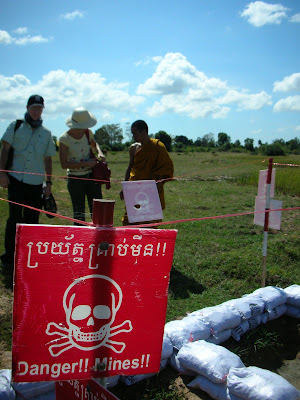

We were in Cambodia for a few weeks to perform some basic engineering tests before repairing the old Trau Kot dam. The dam was part of a major agricultural project by the Khmer Rouge, an earthen embankment built to store water from the rainy season for irrigation during the dry season. A huge section of the old dirt mound had washed away, and we were working to rebuild it in concrete. It was sometimes difficult finding information about the dam's history. Our host's cook had spent years there, forced to work for the KR, and she refused to talk about it at all. Workers were promised rice for their labor, but Ankar had food enough for less than half of the forced laborers. Work was directed by teenage children with guns, and labor was performed by adults. Work animals were well fed while people starved. The educated were despised, and any worker with knowledge enough to recognize the technical errors of the dam would be killed for speaking up. During the KR regime, millions of people were forced out of their city homes, separated from their families, and forced to work in the fields. Two million people were killed. This happened in my own lifetime.

The first day at the dam, we found a few spent AK-47 shells. Bullets were used sparingly by the poorly funded Khmer Rouge regime, and as I stared at the rusty casing in my hand I knew what this one was used for. And if these shells were lying on the ground, it meant we were stepping outside of the zone that had been cleared by the Cambodia Mine Action Committee. We tiptoed back to the oxcart path. The landmine clearing operation was making much progress, and our daily trips to the isolated dam site at Balang Commune were becoming less dangerous by the day.

After dusk, our driver brought us back from the project site, winding through unlit dirt roads, passing oxcarts loaded with timber, a few small motorbikes, and occasionally a smiling, waving child standing at the side of the road. The extreme poverty of the region takes hold at night, when workers return home to their small huts with no electricity or running water. We passed by a hut with a flickering blue light inside. This family had saved enough money to buy a television, powered by car battery. Soon they'd get tired, turn off the tube, roll out a mat on the floor, and go to sleep. They were stuck there, sleeping with the mosquito borne dengue and malaria, the rats, roaches, massive spiders, all the things we were escaping from each night, haunting them, stalking them, slowly enveloping them like a suffocating blanket. It's a jungle, and day by day it moves a little closer to swallowing you if you let it.

Yet in the daylight it's the genuine smile on the face of every stranger that is most engaging, directed, beaming through the dusty roads, and buried within it the pure joy of life, persistence, perseverance.
10.16.2006

First Site Visit: Preliminary Gameplan

Project Description:

A concrete weir structure will be constructed in Cambodia to replace a centuries-old earthen dam that failed in the year 2000. The new concrete dam will abut against the intact portions of the existing earthen dam.

Existing Site Conditions:

Soil ranges from Sand, to clayey sand, to sandy clay. Water table at approx. 1.5 feet below ground surface.
No other soil data exists.

Potential Soil Issues:

Bearing capacity
Shear failure
Settlement
Seepage
Slope Stability
Corrosivity

Design Approach:

The new weir is a concrete counterfort wall constructed on spread footings. We propose over-excavating to remove much of the sandy soil. Then pour a cut-off wall deep below footing to confine seepage flow and minimize effects of seepage to reasonable calculated level.

Seepage analysis shall be performed using the method of flow nets to solve Laplace's continuity equation.

On-Site Soil Testing:

We propose a series of soil tests to be conducted on site in early November. Testing must be highly portable, reliable, and inexpensive. The site is remote, and equipment has to be carried in on the back of a motorcycle.

IN-SITU TESTING:
· Piezometric head --> DRIVE POINT PIEZOMETER
· Porosity (conductivity) --> OPEN END TEST?
· Undrained shear strength (Cu) --> VANE SHEAR TEST (ASTM D4648-05)
· Specific gravity --> sand cone density apparatus (ASTM D1556), or rubber-balloon (ASTM D2167)
· Moisture content --> SPEEDY MOISTURE TEST (CALCIUM CARBIDE REAGENT TEST) (ASTM D4944-04)
· Consolidation --> RECOMMEND COMPACTION PROCEDURES AND DRAINAGE/FILTER LAYER TO MINIMIZE CONSOLIDATION EFFECTS
· Liquid and plastic limits --> STATIC CONE PENETROMETER
· Peak angle of friction (non-cohesive soil/sand) --> CORRELATED TO RELATIVE DENSITY and STATIC CONE BEARING RESISTANCE
· Grain size analysis --> SIEV ANALYSIS
· Soil corrosivity --> SOIL RESISTIVITY MEASUREMENT (ASTM G187) and pH MEASUREMENT
· Organic content --> VISUAL INSPECTION

LAB TESTING:
· Unconfined compression test (Rock) --> NO ROCK CORINGS (assume bedrock is deep, design spread footings to bear on soil)
· Poisson's ratio --> NOT REQUIRED
· Modulus --> NOT REQUIRED

9.06.2006

Water Gate Concept

The preliminary concept for the new water gate structure (dam) at Balang Commune was developed by Mr. Yinn Sovann at the Ministry of Hydrology and Meteorology. We'll have to do some work to verify it's robustness and sustainability, and to ensure it addresses the needs of the community in a comprehensive manner.

7.01.2006

The Cambodia Water Dam Team Is:


JESSICA MILLER - Project Lead
Construction Engineer


WILLIAM CAO - Project Lead
Structural Engineer


BRYSE GABOURY
- Project Lead
Construction Manager


STEVE FORBES
- Team Mentor
Environmental Engineer


SUKH GURUNG
- Team Mentor
Geotechnical Engineer


TIM WEISS - Outreach, Fundraiser, Impact Assessment
Construction Engineer


KENNETH GATLIN - Design Team
Hydrological Engineer


RYAN WOODWARD - Technical Discipline Lead
Structural Engineer


JASON CHAN - Design Team
Hydrogeologist


MATT BUSSMAN - Design Team
Structural Engineer


JENNIFER LOHR - Design Team
Hydrogeologist


TIM LAVIN - Design Team
Hydrological Engineer


MICHAEL PUCCI - Design Team
Hydrological Engineer


MATT BARBER - Impact Assessment, Fundraiser
Structural Engineer


MONICA LOUIE
- Design Team
Environmental Engineer


MARK SHEERAN
Construction Engineer


MARIA JARINA - Impact Assessment, Fundraiser
Structural Engineer


LINDA HAMDEN - Impact Assessment, Fundraiser
Mechanical Engineer


DAN GARCIA - Fundraiser
Strucural Engineer


Albert Yi Cheung Lok - Fundraiser
Materials Engineer


DEBRA MOOLIN
Structural Engineer


DUSTYN ROBERTS
Robotic Engineer


JONATHAN RAUSCHER
Hydrological Engineer


KATHERINE MCCULLOGH
Graphic Designer


LAWRENCE PARRINGTON
Robotic Engineer


ALEXANDRE REMNEK

Environmental Engineer


PHIL RITZ

Environmental Engineer


TERESA LLORENTE
Structural Engineer


TIM THOMPSON
Geotechnical Engineer