Project Description:
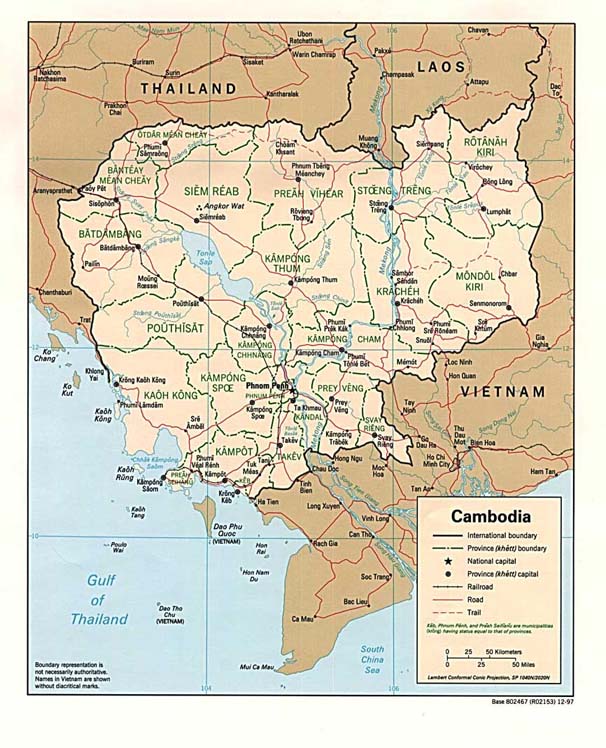
A concrete weir structure will be constructed in Cambodia to replace a centuries-old earthen dam that failed in the year 2000. The new concrete dam will abut against the intact portions of the existing earthen dam.
Existing Site Conditions:
Soil ranges from Sand, to clayey sand, to sandy clay. Water table at approx. 1.5 feet below ground surface.
No other soil data exists.
Potential Soil Issues:
Bearing capacity
Shear failure
Settlement
Seepage
Slope Stability
Corrosivity
Design Approach:
The new weir is a concrete counterfort wall constructed on spread footings. We propose over-excavating to remove much of the sandy soil. Then pour a cut-off wall deep below footing to confine seepage flow and minimize effects of seepage to reasonable calculated level.
Seepage analysis shall be performed using the method of flow nets to solve Laplace's continuity equation.
On-Site Soil Testing:
We propose a series of soil tests to be conducted on site in early November. Testing must be highly portable, reliable, and inexpensive. The site is remote, and equipment has to be carried in on the back of a motorcycle.
IN-SITU TESTING:
· Piezometric head --> DRIVE POINT PIEZOMETER
· Porosity (conductivity) --> OPEN END TEST?
· Undrained shear strength (Cu) --> VANE SHEAR TEST (ASTM D4648-05)
· Specific gravity --> sand cone density apparatus (ASTM D1556), or rubber-balloon (ASTM D2167)
· Moisture content --> SPEEDY MOISTURE TEST (CALCIUM CARBIDE REAGENT TEST) (ASTM D4944-04)
· Consolidation --> RECOMMEND COMPACTION PROCEDURES AND DRAINAGE/FILTER LAYER TO MINIMIZE CONSOLIDATION EFFECTS
· Liquid and plastic limits --> STATIC CONE PENETROMETER
· Peak angle of friction (non-cohesive soil/sand) --> CORRELATED TO RELATIVE DENSITY and STATIC CONE BEARING RESISTANCE
· Grain size analysis --> SIEV ANALYSIS
· Soil corrosivity --> SOIL RESISTIVITY MEASUREMENT (ASTM G187) and pH MEASUREMENT
· Organic content --> VISUAL INSPECTION
LAB TESTING:
· Unconfined compression test (Rock) --> NO ROCK CORINGS (assume bedrock is deep, design spread footings to bear on soil)
· Poisson's ratio --> NOT REQUIRED
· Modulus --> NOT REQUIRED


9.06.2006
Water Gate Concept
The preliminary concept for the new water gate structure (dam) at Balang Commune was developed by Mr. Yinn Sovann at the Ministry of Hydrology and Meteorology. We'll have to do some work to verify it's robustness and sustainability, and to ensure it addresses the needs of the community in a comprehensive manner.

7.01.2006
The Cambodia Water Dam Team Is:

JESSICA MILLER - Project Lead
Construction Engineer

WILLIAM CAO - Project Lead
Structural Engineer

BRYSE GABOURY - Project Lead
Construction Manager

STEVE FORBES - Team Mentor
Environmental Engineer

SUKH GURUNG - Team Mentor
Geotechnical Engineer

TIM WEISS - Outreach, Fundraiser, Impact Assessment
Construction Engineer

KENNETH GATLIN - Design Team
Hydrological Engineer

RYAN WOODWARD - Technical Discipline Lead
Structural Engineer

JASON CHAN - Design Team
Hydrogeologist

MATT BUSSMAN - Design Team
Structural Engineer

JENNIFER LOHR - Design Team
Hydrogeologist

TIM LAVIN - Design Team
Hydrological Engineer

MICHAEL PUCCI - Design Team
Hydrological Engineer

MATT BARBER - Impact Assessment, Fundraiser
Structural Engineer

MONICA LOUIE - Design Team
Environmental Engineer
MARK SHEERAN
Construction Engineer

MARIA JARINA - Impact Assessment, Fundraiser
Structural Engineer

LINDA HAMDEN - Impact Assessment, Fundraiser
Mechanical Engineer
DAN GARCIA - Fundraiser
Strucural Engineer
Albert Yi Cheung Lok - Fundraiser
Materials Engineer
DEBRA MOOLIN
Structural Engineer

DUSTYN ROBERTS
Robotic Engineer
JONATHAN RAUSCHER
Hydrological Engineer
KATHERINE MCCULLOGH
Graphic Designer

LAWRENCE PARRINGTON
Robotic Engineer

ALEXANDRE REMNEK
Environmental Engineer

PHIL RITZ
Environmental Engineer

TERESA LLORENTE
Structural Engineer
TIM THOMPSON
Geotechnical Engineer
Subscribe to:
Posts (Atom)