3.31.2007

soil samplin'

This phase of the construction requires keeping a keen eye on the type of soil being used for the fill material. The borrow location is inside the basin and was predetermined from our first site assessment last November. CMAC had finished clearing that area a few weeks ago.


Matt taking a look at the excavated borrow area.
Bryse scooping up a bowl for sampling.

Soil can be good at one location, then bad a few feet later. Every time the excavator dumps a heap into the truck, we must check that soil. For example, in one location, a 7’ deep pit yielded nothing but very sandy soil. After rejecting this pit, another one was dug about 50 yards away to find the pre-approved sandy silty loam sitting 5’ below ground. Sandy silty loam is more available in abundance in this area.


One can see the layers of the soil. The first 1’to2’ is organic material, followed by 2’to3’ of fine sands, followed by the approved fine sandy silty loam.

A closer look, Bryse holding the sandy silt loam in the left, and sandy soil on the right.


The soil was stove dried in the field, and varying moisture content bags were made to develop an intuitive understanding of how the soil feels at different moisture content. Shown above are bags with 8%, 10%, 12%, and 14% moisture content.


A long day in the field is followed by a long session of soil classification based on the Unified Soils Classification System (USCS). This requires sieving through a #10, #40, and #200 sieve, followed by performing the plastic and liquid limit (aka Atterberg Limits).


The soils lab was set up at our friendly guesthouse’s patio area and on top of the bbq grill.

3.30.2007

The South Embankment

This first phase of repair work is on the existing West embankment but the South and North embankments need to be repaired in the later phases. The existing South embankment is not as big as the main West embankment. The photo above is where the south canal exits the reservoir and it's almost a perfect cross section of the embankment.

We are planning to install a small concrete water gate or a slightly modified box culvert at this South canal, like in the photo above, so the top of this South embankment can be used as a road and the water supplied to the canal can be controlled.


This photo is of the Tim and wiL taking a soil boring at the South embankment. We were boring in the dark last night, being eaten alive by giant mosquito's.

3.28.2007

Staying in the Village


On Monday night we spent the night at Prom Kod, one of the villages in the Balang Commune. We were working on site that day until pretty late so by the time we showed up at the village it was already dark but Mean Someth was there with a huge smile to welcome us. We were directed to wash our feet at the well then we were brought into the house and served dinner. As we ate it looked like more and more people were coming to the porch to watch us eat so I took a picture and the flash illuminated an entire audience of smiling, curious villagers staring at us take every bite of our dinner.


We woke up early in the morning to the sound of farm animals then packed up and Someth led us back towards the site. On the way we climbed up to an ancient Angkorian ruin called Chao Seri Vibowl next to Wat Trach, a Buddhist pagoda. A small group of villagers arrived shortly after to pray. Someth sat down with them to explain who we were and the project we are working on. As we left the pagoda we bowed to the villagers and they smiled and thanked us. Tobias later explained to us that Someth grew up in Balang then left to start an NGO in Siem Reap and now has an almost celebrity status amongst the local villagers.

3.25.2007

Mean Someth


Yesterday wiL, Tobias and I met with Mean Someth the director of Human Resource and Natural Development (HRND). Someth was the person that originally introduced the water gate project to Human Translation back in 2004. HRND has not been as involved with the technical aspects of the project but we discussed the surrounding communities involvement after completion. It was an inspiring meeting. Beyond the water gate, some of the projects HRND are working on are a rice bank, home gardening education, mirco-financing and there were discussions on future projects in language education and encouraging tourism in the area.
Our group has had many discussions about the Water Management Group; the people that will manage the maintenance and operation of the water gate and distribution of water stored in the reservoir. With the community connections developed by HRND it sounds like they are perfectly suited to help with the organization of this management group.

3.24.2007

kap'bodia

KAP is Kite Aerial Photography. A KAP jig would house a camera, and remote controlled servos would rotate, tilt, and also hit the shutter release button. Details on the KAP jig.


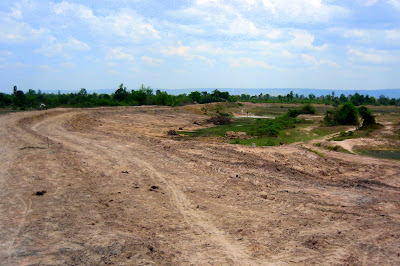
Here are some first images from KAP approximately 350' high. We were able to take many impressive soaring photos of the basin area. Shown above are photos looking west at the west embankment. You can see where the stream has breached through the embankment, causing a 60' wide gap. All of the vegetation and top soil has been cleared. The crest of the embankment is being leveled, and initial compaction has already begun. In the distance, you can see the downstream path, the small divisions of the rice patties, and the mountain Phnom Bok. Doing KAP was a 4 people effort. Chai was focused on flying the kite, Tobias manned the remote transmitter, wiL constantly had to untangle all the knots (somehow you ALWAYS get knots), and Bryse to stand in every downward shot with a pvc pole pointing North for point of reference and scale of photo.

Here's Chai feeding up the KAP unit. after a couple of trial and error, we figured out a strategy to get the unit up. attaching the unit too close to the kite causes difficult initial launching, since the wind at ground level is not usually as strong to lift the unit. launching the kite by itself for the initial 100' or so allows the kite to catch onto stronger winds above, hence, "locking" the kite up there. at this point, attaching the KAP unit to a newly tied knot will easily draw the entire unit up.

Left to right: two local spectators, Tobias controlling the remote, Chai teasing the kite, wiL feeding the line.

3.23.2007

Some more pics from 'bodia


Before and After


These images are pretty small but we can't upload anything larger. But check out the difference in the site since the last site assessment! We were absolutely amazed at the pace of construction so far. wiL should get his Kit Ariel Photograph up and running tomorrow so we'll try to send some pics soon.

3.22.2007

Photos 22 March 2007


Construction has started, and Bryse and wiL are in Cambodia. Here's a photo of the embankment progress. The contractor has nearly finished clearing the vegetation. They'll begin filling and compacting the embankment soon!

3.14.2007

Next Week


wiL and I will be in Siem Reap in less than a week! I've been too busy to prepare myself for the culture shock but I'm really excited to eat weird food, meet all of the people involved with the project and see the site. HT emailed us that the Opening Ceremony is planned for this Saturday. We have a detailed schedule of activities but we're probably going to be completely overwhelmed with the embankment repair construction.
(this is one of Ryan's photos from the first trip)

3.12.2007

Org Chart

During last weeks conference call, we discussed the organization of the project with Human Translation (HT). The important aspects of the organization chart is that the QA/QC person has a check on the Construction Manager, HT has the final word in any disputes between the two and, apparently, David reports to EWB.

3.11.2007

Last Nights Concert

Last night's concert was a big success! It started with a decent crowd of EWBers and friends and turned into a legitimate concert with everything from great music to difficulty navigating through the crowd. Thanks again to everyone that worked on putting this really fun even together!

3.07.2007

Site Survey


One aspect of this project that is still unknown is the volume of water this reservoir will typically hold. Apparently, the basin looks like a huge field and, other than the main embankment, the basin is surrounded by gradually inclining hills. This is one of the reasons we need a detailed site survey. We already have some topographic maps of the area but the entire reservoir fits between the contour lines provided.


By reviewing this detailed survey information with the annual rainfall data we are hoping to better understand the capacity of water this reservoir will provide to the surrounding canal systems. The next step will be a review of the canal system. A detailed survey of the canals would not be possible due to limited resources and safety concerns. However, our ideas for getting around a detailed survey of the entire canal system are first to find GPS points along the canals and second to use Kite Areal Photography (KAP) to photograph the system. (pretty excited about trying the KAP)

Design Update

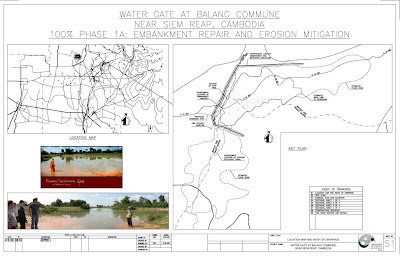
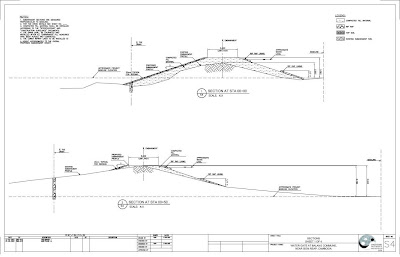
We submitted a drawing set for the embankment repairs tonight. Construction for phase 1 should start pretty soon!


Following this phase, we'll return during the next dry season to repair the canal system and build the concrete water gate (phases 2 and 3).

3.06.2007

Concert for Cambodia


Dan Garcia and Eddie Tadross have been working very hard for the past few months on putting together a benefit concert for the Cambodia project and the EWB-NY Chapter. After a long search of bars in Manhattan and Brooklyn they were able to get a ridiculously good deal at a place in the Lower East Side on a Saturday night. Plus, they signed up three bands and a DJ. There were many other members of the group that helped along the way and even more people are helping with all of the last minute preparations this week.

Here is the info on the concert:

Engineers Without Borders, New York Chapter presents:
Concert for Cambodia

Saturday, March 10 at Fontana's, 105 Eldridge St
Lower East Side of Manhattan
Doors open at 8PM; cost is $10 at the door

PERFORMING ARTISTS
Zigmat
Inflowential
Meta and the Cornerstones
DJ Lechuga

Proceeds will help EWB-NY complete the Balang Dam and other projects.

3.05.2007

Organized Chaos


For the last few weeks we have been preparing for our second site assessment trip to Cambodia. Most of the preparation has consisted of many long conversations about what we need to accomplish and discussing the best ways to accomplish everything. When the first team left for Cambodia last November we had almost no idea what to expect. But from that first trip we have gained a much clearer view of the project and we are trying to build on the first teams experience during this next trip.
So, things we need to accomplish on this trip:
1. Phase I – Embankment Repair
A. Review the downstream side of the embankment to determine the best route for the toe drain.
2. Phase II – Canal System
A. Obtain surveying points relating the South-East canal to the future water gate.
B. Obtain GPS points of as much of the canal system as possible.
C. Review the canal system for possible culvert locations.
3. Phase III – Water Gate
A. Divert the stream and test the soil beneath the area of the future water gate.
4. Community/Health Assessment
A. Interview Human Translation and locals within the community.
It seems pretty straight forward but apparently things typically take twice as long over in Cambodia plus it’s hard to not to worry things that may go wrong. For example, check out wiL’s leach bite from the first trip. It seems like whenever you travel in a foreign country there are unexpected things, good and bad, and as much as we are trying to plan everything we’re probably going to have to be very flexible and ready for things to not go as planned.

3.04.2007

Project Update

In the rainy season of 2000, an earthen dam in a rural area outside of Siem Reap, Cambodia was washed out leaving thousands of residents without sufficient water for irrigation. The surrounding villagers live in extreme poverty. Local families are primarily rice farmers, yet during the dry season they are unable to grow rice because of arid conditions and a lack of proper water storage and irrigation. This has left many crushed by poverty, unable to rally resources in order to improve their standard of living.

In Cambodia, non-governmental organizations (NGO’s) fund the majority of infrastructure projects. A few groups are working together to complete this initiative including the Commune Council, monks from the temple at Wat Trach, Human Translation, and Engineers Without Borders (EWB). The monks at Wat Trach targeted this project and worked with the Ministry of Hydrology to come up with a conceptual design to repair the dam. Human Translation, a USA based NGO, became involved in the project and reached out to EWB for engineering expertise.

The rebuilding of the dam will be implemented in three phases to ensure the use of local farmers for labor, paid in rice, and to reduce construction costs by eliminating the need to use a contractor for all but the most technically challenging aspects of construction. The goal is to have the farmers that will directly benefit from this project be the people contributing their time and effort into building. We hope that this will provide a sense of ownership for the community. Phase one, beginning March of 2007, will focus on repairing the intact portion of the 600-meter-long embankment which has been severely eroded. Phase two will take place at the start of the next dry season, and will include repairing the existing canal system. Construction will conclude with Phase three, during which a concrete water gate will be erected by a Cambodian contractor to fix the current hole in the embankment.

In November of 2006 EWB sent three team members to Cambodia for the first site assessment. In order to successfully complete this site assessment the team had to overcome many constraints. The majority of the area has no electricity and very little infrastructure due to years of war followed by decades without maintenance. This lack of resources forced the team to create improvised engineering techniques with material available. Unique issues concerning this site were discovered such as the possibly of land mines in the area and structurally unsound bridges on the road leading to the dam. In addition to these challenges, the team explored possible new projects for Engineers Without Borders.

Working under a tight time limit, Ryan and his fellow engineers researched the area, reviewed engineering techniques, and studied the design for the new dam. Since the team could not acquire precision engineering equipment in Cambodia, they brought a scale and a number 200 sieve, and they developed innovative methods to build other engineering tools from light weight, portable, and easily acquired materials. The team improvised and created two additional sieves using rice screens, and constructed a bore hole permeameter from a bucket, hose, and a simple plastic valve, all purchased at the local market. They had a hand auger fabricated at a local metal shop. Things move slowly in Cambodia, and this required a longer stay in order to finish the preliminary engineering work.

Throughout the month, the team traveled 1.5 hours each direction to Balang Commune. “Our first day at the job site, we were surprised to see the Cambodia Mine Action Committee at work. We were misinformed that the site had been cleared of landmines years ago.” The team was further surprised to learn the dam was constructed as a forced labor project in the 1970’s under the Khmer Rouge communist regime, contrary to their previous research of the area. During the brief occupation of 1975-79 and the ensuing years of war, the Khmer Rouge Regime placed landmines throughout the country, in most cases specifically targeting civilian areas. The Cambodian Mine Action Centre (CMAC) estimates that four to six million landmines remain in the country, making Cambodia the most densely mined country in the world today. The project site, rarely traveled and covered with lush vegetation, was identified as having a high likelihood of being mined. This limited the EWB team to working within areas already cleared by CMAC. On their last day at the site, CMAC workers found and detonated three unexploded ordinance (UXO’s) on the embankment dam.

On another occasion, the team discovered a timber bridge on the route to the dam is falling apart. After a quick inspection, the team spotted beams that had failed due to overloading and recognized signs that other areas were structurally compromised. The bridge will have to be repaired in order to transport the equipment needed to fix the dam, and in order to ensure the safety of its many daily users. “We’re using simple, readily available construction materials that can be installed by local residents using only hand tools, with the hope that this experience will improve the community’s collective knowledge base and lead to better locally built structures in the future.”

While working, they also identified a few additional projects EWB could potentially become involved with in the future. One team member has suggested a project to mitigate deforestation north of the job site, where farmers have been clearing the land during the dry season as a supplemental form of income. A solution could be simple reforestation, or alternatively a concept to plant trees bearing fruit that can be sold at the market. Another NGO has proposed using the reservoir for small-scale fish farming. The EWB team could become involved to help recommend simple measures to reduce downstream pollution from the fish farm effluent.

EWB faces a major challenge ahead, instilling within the community a sense of ownership in order to ensure the project’s long-term sustainability. During this first site visit the team met with the local government officials numerous times to discuss the project. The team plans to continue working with the local officials to create a Water User Group. This Water User Group will be a local, elected management board responsible for the maintenance and inspection of the dam and equitable water distribution within the communities. EWB plans to continue contact with the community well after project completion to ensure the effectiveness of this Water User Group and the long-term success of the project.

1.25.2007

Embankment Concept

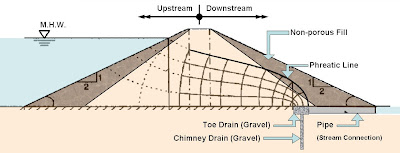
We're gonna need to do some serious work on the intact portions of the earthen embankment before we can build the new concrete water gate (dam).

Some of this work will include:
- Clear vegetation
- Install and compact a layer of clay to restore the embankment profile
- Install a toe drain to capture any seepage and mitigate downstream flooding
- Throw down some riprap to protect the upstream side
- Grass seeding on the downstream slope to prevent erosion

12.08.2006

Bayon Temple


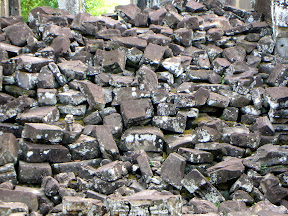
A big pile behind Bayon. Blocks, cracks, a lintel, some lichen, simultaneously the highest and lowest points in the history of a society.

I'm shocked by the aweful extent of destruction perpetrated by the Khmer Rouge. Even the jungle - asserting, owning the things it contains - would only slowly swallow, dissolve these thousand year old temples. By contrast, these great embodiments of human creation have been destroyed in explosive displays of power, and it seems to me a sign we're condemned to spend our lives undoing and redoing our greatest works.

Each stone here will one day be meticulously cataloged. How much easier will it be to rebuild the temple the next time we destroy it?

12.07.2006

Wood Bridge


Some days the scope of our project seems to be multiplying.

The Commune Chief brought me to a small timber bridge today on the way to the dam site. He pointed out some broken planks and asked me to take a quick look underneath. A few of the rather small but critical beams have broken due to overloading. There appears to be no structurally reliable foundation at all. And several of the columns have large grooves cut into them from their previous life as part of a house down the road.

We've driven our heavy 4WD van over this bridge every day for the past month, but seeing it now from underneath, I wouldn't feel secure driving a small car over it. It's not safe, and it's rather heavily trafficked for a rural road. I'm worried it could collapse at any moment without warning.

We'll need to bring some heavy machinery over this bridge for the dam project. That means we'll have to do some repair work on the bridge before we can get construction rolling on the dam.

12.06.2006

Last Day on the Site


I'm still in Siem Reap. The other guys had to go back home to their day jobs last week. We met with the district governor and the Commune Council this morning to discuss their role in coordinating labor and machines. Tomorrow I'll return to the site for the last day of field work.

Here's a summary of project issues we'll face ahead:

a) Erosion is significant, and large quantities of material have been excavated from the downstream toe at the southerly end of the dam. We'll have to move large quantities of dirt, and will have to verify clayey quality of all borrow material. I have identified some ideal borrow locations that will at the same time improve significantly the reservoir capacity and streamflow direction, while reducing overall effects of evaporation.

b) Canal system has to be designed anew, whether we opt to restore the old canals or construct new ones

c) Much of the work can be self-performed by HT using local labor, under the direction of their construction engineer on staff, Mr. Chanda (he has much construction experience, and has more than demonstrated his competence and dedication during our visit)

For these reasons, we're discussing a different phased construction concept (as opposed to contracting the entire project):

1. Embankment Repair (begin March 2007)
- HT to self-perform this task, using Mr. Chanda as resident engineer
- use 1 excavator, 2 dump trucks, 1 compacting roller (available free from Province)
- local labor to move and spread the material dumped from the trucks (paid in rice)
- local labor to clear vegetation / prepare embankment for repairs
- local labor to plant new landscaping

2. Canal Restoration (begin October 2007)
- HT to self perform this task, using Mr. Chanda as resident engineer
- same equipment and labor as above

3. Water Gate (November 2007)
- Hire contractor, using minimum 10% local labor
- Ideal duration of bid process is four months

4. Inspection and Maintenance Program
- generate community understanding of importance of proper maintenance

5. Community Outreach Program (ongoing task, performed by HT)
- assess community needs (health, irrigation, etc)
- establish clear understanding with community members regarding project benefits
- resolve land rights issues among parties farming within the reservoir basin area